Gallery
Underground site-specific exhibition 1980 signed note
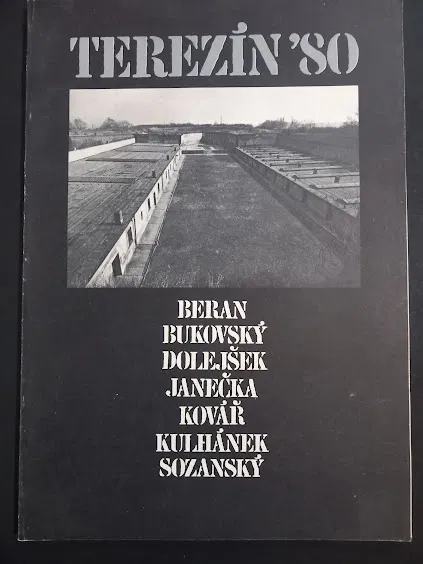
Terezín ’80.
Beran, Zdeněk; Bukovský, Ivan; Dolejšek, Ivan; Janečka, Lubomír; Kovář, Petr; Kulhánek, Oldřich; Sozanský, Jiří.
Designed by Joska Skalník. Photographs by V. Brzobohatá, P. Hron, P. Kovář, J. Putta, P. Zhoř.
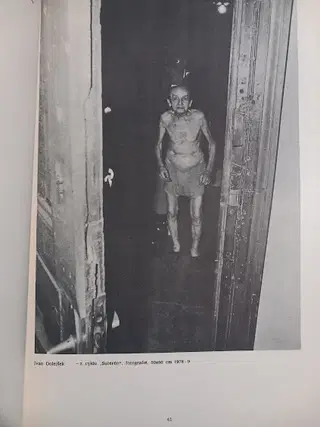
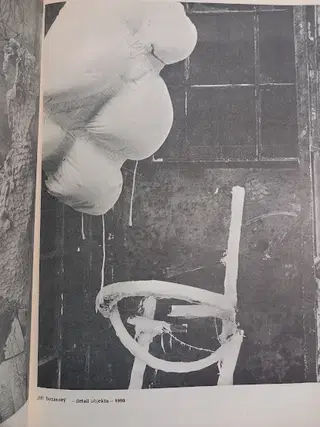
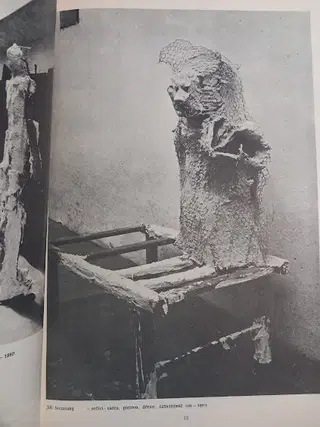
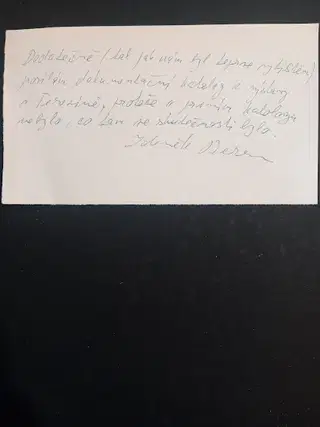
4to (c. 29 x 21 cm). 69 pp. Black-and-white photographic plates throughout. Original printed wrappers. Laid in is an autograph note by Zdeněk Beran, which reads:
"Dodatečně (tak, jak nám byl teprve vytišten) posílám dokumentační katalog z výstavy v Terezíně, protože v prvním katalogu nebylo, co tam ve skutečnosti bylo. Zdeněk Beran."
Translation: “Additionally (as it was finally printed), I am sending the documentation catalogue from the exhibition in Terezín, because the first catalogue did not contain what was actually there. Zdeněk Beran.”
This note makes explicit that the present catalogue was published outside official structures by the artists themselves, in order to correct or replace the inadequate “first” catalogue prepared under the auspices of the Terezín Memorial.
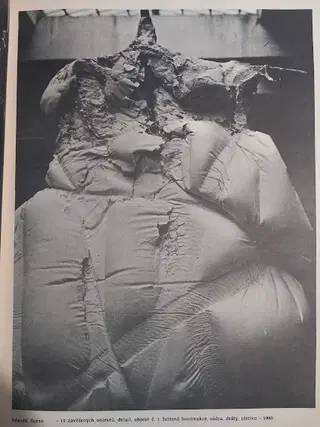
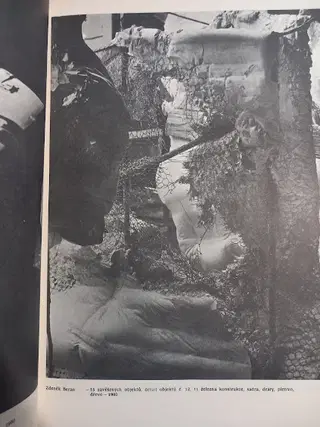
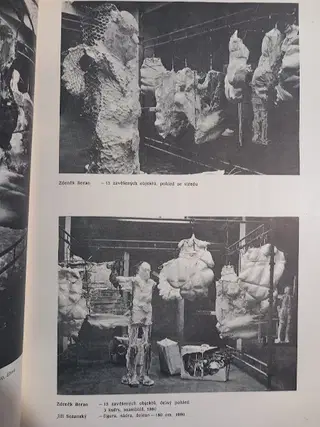
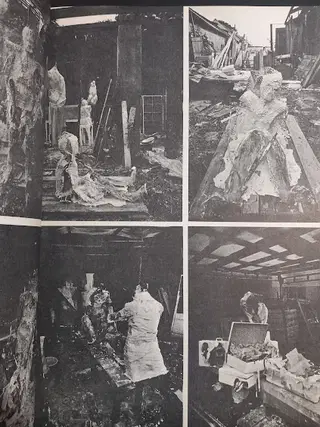
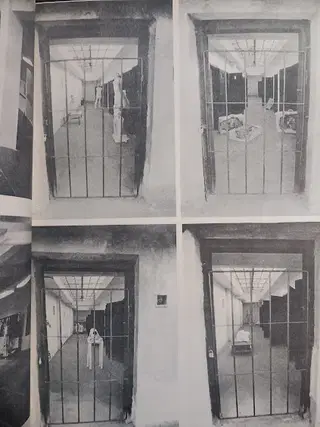
Unofficial catalogue of the underground exhibition Terezín ’80 (also known as Pevnost 1980), an illegal artistic intervention in the fortress of Terezín in 1980. The project was organized by Jiří Sozanský together with fellow artists including Zdeněk Beran, Ivan Bukovský, Oldřich Kulhánek, and others, who installed objects and environments directly into the prison spaces of the Small Fortress. The Terezín intervention was essentially a site-specific artistic happening carried out illegally in the fortress spaces, with installations responding to the Holocaust history of the site.
Contemporary accounts describe it as a collective environment project in semi-secret conditions — tolerated for a short while but not publicly promoted, and the works were dismantled or destroyed soon after.
Only much later (after 1989, and especially in 2021 with the memorial show Pevnost 1980) was it acknowledged and commemorated in official institutions like the Terezín Memorial.
During the 1970s and 1980s, when official cultural policy in Czechoslovakia excluded him from public life, Zdeněk Beran developed a body of unofficial work shown only in private studios, clandestine gatherings, or ephemeral installations. He created environments such as Rehabilitační oddělení Dr. Dr. (Rehabilitation Ward of Dr. Dr., 1971–72), a grotesque parody of medical spaces filled with absurd prosthetic machines and bandaged forms that blurred the line between healing and torture. Using plaster, wire, textiles, and organic matter, Beran produced objects that resembled decaying torsos, pathological specimens, or bloated suitcases, all marked by a fascination with fragility and decomposition. His most powerful intervention of this period was his contribution to Terezín ’80, when he suspended fifteen monstrous objects that evoked both executed bodies and the luggage of deported prisoners, a chilling embodiment of historical trauma. These works, fragile and often destroyed after their creation, circulated primarily through photographs and samizdat catalogues, ensuring that Beran’s radical explorations of decay, memory, and the grotesque persisted even under censorship.
Inv. H7ob